How Strong Website Messaging Builds Trust and Drives Conversions

You arrive on a website and within four seconds, your gut either relaxes or tightens. That reaction is a consequence of its messaging, which either works perfectly or fails quietly.

Most businesses fill their homepages with phrases that sound important but land miserably. “Innovative solutions.” “Next-level service.” “Unlocking potential.” Your audience doesn’t speak this language, and honestly, they don’t trust it.

Strong messaging does something braver. It risks being specific. It names the problem your customer faces and hands them something recognizable. That connection is the moment trust sparks, and without it, no button color or urgency tactic will save your conversion rate.

With that in mind, we’ll show you how to strip away the performance, find the real words your customers use, and turn your website into a place where trust arrives naturally and decisions happen faster.

Clear Value Propositions That Build Instant Trust

When a visitor lands on your website, they’re making a split-second decision. Your value proposition is what that decision hinges on – one clear statement that tells them exactly what you offer and why they should care.

Brands that nail this tend to grow faster. Research shows that a strong value proposition can drive brand growth by up to 76% over time. That means that when people immediately understand what you do, they’re far more likely to stick around.

Here’s how to write one that works:

  • Start with the outcome, not the feature. Your customers seek results, not products. Lead with the specific problem you solve or the benefit you deliver, and cut everything that doesn’t serve that.
  • Keep it short. One sentence is ideal. Two is acceptable. Anything longer and you’ve lost the thread.
  • Test it on someone who doesn’t know your business. If they can tell you exactly what you do after reading it, you’re on the right track. If they hesitate, rewrite it.
  • Place it prominently above the fold, center stage, impossible to miss.

Let’s see how this works in the real world:

Spotminders is a brand that makes ultra-slim tracking devices designed to help people keep tabs on everyday essentials like wallets and bags. So, their value proposition does exactly what it should. It zeroes in on the core fear their customers have and addresses it head-on, in plain language, with zero fluff.

This way, visitors don’t have to dig through the site to figure out what the product does. The message meets them immediately. That instant clarity is what makes it effective.


Source: spotminders.com

Copy That Makes Visitors Feel Understood

People don’t trust brands they can’t relate to. When your copy reads like a product brochure, they disengage. When it reads like you’ve been in their shoes, they lean in.

The difference between copy that converts and copy that doesn’t often comes down to who it’s about. Most businesses write about themselves – their features, their process, their credentials. The websites that actually connect with visitors write about the customer’s world instead.

Here’s how to make your copy resonate:

  • List the frustrations your customers have before they find you.
  • Write to those frustrations directly, using the same language your customers use, not industry jargon or polished marketing-speak.
  • Pull your customer reviews and support emails. The phrases people use to describe their problems are often the exact phrases that should appear in your copy.
  • Mirror that language back to them, and they’ll feel like you already understand their situation.
  • From there, shift your copy’s focus from features to outcomes. Instead of describing what a product does, describe what life looks like after using it. Lead with the “after,” and back it up with the specifics.

Drift makes car and home fragrances – a niche where it’s easy to default to generic product descriptions.

Instead, their copy taps into how customers want to feel and what atmosphere they’re trying to create. Rather than pushing ingredients or diffusion technology, Drift speaks to the mood and the moment.

That adjustment, from product details to personal experience, makes their messaging feel far less like advertising and a lot more like a conversation.


Source: drift.co

Messaging That Builds Emotional Connection and Loyalty

Logic might justify a purchase, but emotion drives it. Research at Harvard suggests that 95% of purchasing decisions happen subconsciously, meaning most people decide how they feel about your brand before they’ve consciously processed a single fact about it.

Brands that connect with customers on an identity level (speaking to who they are or who they want to become) build loyalty that purely functional messaging never achieves.

Here’s how to build emotional connection through copy:

  • Figure out what your customers want to believe about themselves, and reflect that back in your messaging. This is simple alignment, not manipulation. When someone sees their values and aspirations mirrored in your brand, they feel a genuine sense of belonging.
  • Use tone deliberately. Warm, conversational language creates closeness. Confident, direct language creates trust.
  • The right combination depends on your audience, so listen to how they talk about their goals and frustrations, then match that energy.
  • Avoid vague inspiration. Emotional messaging works best when it’s grounded in something specific, like a real problem, a tangible outcome, or a clear identity statement.

A brand that excels here is Brain Ritual, offering science-backed supplements targeting brain health, with a specific focus on people who live with migraines.

Their messaging goes well beyond listing ingredients. They speak directly to the exhaustion of managing symptoms and the desire for a real, lasting solution. Phrases like “tackles a root cause, not symptoms” and “helping migraine sufferers” position the brand as an ally in a genuine health struggle.

That framing builds trust and emotional investment simultaneously. That’s the combo that turns first-time buyers into loyal customers.


Source: brainritual.com

Trust-Building Copy That Doesn’t Feel Too Salesy

Visitors are good at sensing when a website is pushing too hard. The moment your copy starts to feel like a pitch, trust erodes. Once that happens, it’s difficult to recover within a single session.

The brands that convert consistently aren’t necessarily the loudest or the most persuasive. They’re the ones that make visitors feel informed rather than pressured. That distinction shapes everything from headline choices to how you frame your CTAs.

Here’s how to write copy that earns trust:

  • Lead with value before you ask for anything. If every section of your site is angled toward a sale, visitors pick up on that quickly.
  • Balance conversion-focused copy with genuinely useful information that serves the reader regardless of whether they buy.
  • Watch your language. Words like “exclusive,” “limited,” and “act now” trigger skepticism in most readers.
  • Replace urgency-driven phrases with confidence-driven ones, like copy that demonstrates why you’re the right choice rather than pressuring someone into a decision.
  • Let your proof do the heavy lifting. Testimonials, credentials, data, and transparent policies communicate trustworthiness far more effectively than self-promotional claims ever could.

Mesothelioma.net provides free guidance and resources for people navigating a mesothelioma diagnosis. This is an audience that’s vulnerable, overwhelmed, and highly sensitive to anything that feels exploitative.

So, their copy rises to meet that responsibility. Every page prioritizes clarity and empathy over conversion pressure. The tone stays consistent, the language stays supportive, and the focus stays on helping readers understand their options.

That approach builds deep credibility with an audience that has every reason to be cautious. That credibility is what drives engagement.


Source: mesothelioma.net

Turning Product Features Into Customer Benefits

Features describe what a product does, while benefits describe what a customer gains. Most websites lead with the former and leave visitors to figure out the latter on their own. That’s why most visitors don’t bother.

This oversight is one of the most common reasons technically strong products underperform online. The product itself isn’t the problem. The translation is.

Here’s how to make the shift:

  • Run every feature on your website through a simple filter: “What does that mean for the customer?
  • Keep asking that question until you land on something tangible, like a problem solved, a friction removed, or a result achieved.
  • For example, “256-bit encryption” is a feature. “Your data stays private” is a benefit. “Made with cold-pressed ingredients” is a feature. “Better absorption, faster results” is a benefit.
  • The feature earns credibility. The benefit earns interest. You need both, but lead with the benefit.
  • Structure your copy so the benefit comes first and the feature follows as the supporting evidence.
  • Also, keep benefits specific. “Improves your life” means nothing. “Helps you stay energized through a full workday” means something.

A notable brand here is Mind Lab Pro, selling cognitive enhancement supplements. This category is usually packed with dense ingredient lists and scientific terminology that can easily alienate non-specialist buyers.

That’s why their messaging takes a different approach. Rather than leading with formulation data, they connect each ingredient to a concrete mental or lifestyle outcome, like sharper focus, better recall, sustained productivity. The science stays present for credibility, but the benefits drive the narrative.

That balance makes complex information accessible without dumbing it down.


Source: mindlabpro.com

Social Proof Messaging That Reinforces Confidence

Nobody wants to be the first person to take a chance on a brand they’ve never heard of. That’s just human nature, and smart website messaging works with it rather than against it.

Research backs this up. Around 90% of buyers say some form of social proof, whether expert recommendations, product reviews, or customer testimonials, shaped their thinking during the research stage. That means by the time someone reaches a decision, peer validation has already done most of the heavy lifting.

Here’s how to use social proof effectively:

  • Place it where doubt is highest. That’s usually near your CTA, on your pricing page, or right at the top of your homepage, where first impressions form.
  • Don’t bury testimonials at the bottom where only the most committed visitors will find them.
  • Be specific with your proof. “Great product!” convinces nobody. A testimonial that describes a specific problem solved, with measurable context, lands with far more weight.
  • Where possible, include names, photos, and relevant details that make the reviewer feel real.
  • Diversify your proof types. Star ratings, press mentions, case studies, certifications, and user counts each carry different weight with different audiences. A combination builds a more complete picture of credibility.

A great example is Visp, a brand offering portable, travel-friendly drinkware fitted with built-in electric whisks. Their homepage wastes no time establishing trust.

Visitors are greeted immediately with a customer count running past 50,000 happy buyers, followed by a rolling carousel of recognizable media outlets that have featured the brand.

That combination (volume of customers plus third-party recognition) signals legitimacy from the very first scroll, before a visitor has read a single product description.


Source: drinkvisp.com

Calls-to-Action That Guide Visitors Toward Conversion

A visitor who understands your value proposition, feels understood by your copy, and trusts your brand still needs one final nudge. That’s the job of a call-to-action – something that the majority of websites handle poorly.

Generic CTAs like “Click Here,” “Learn More,” or “Submit” tell visitors nothing about what they’re getting or why they should care. They’re missed opportunities dressed up as buttons.

Here’s how to write CTAs that actually work:

  • Match your CTA to the visitor’s intent at that specific point in their journey. Someone reading a blog post is in a different mindset than someone on a pricing page. One might respond to “See How It Works,” while the other is ready for “Start Your Free Trial.” Context changes everything.
  • Use outcome-oriented language. Instead of describing the action (“Sign Up”), describe the result (“Get My Free Report”). That small difference reframes the CTA from a task into a benefit.
  • Limit choices. Multiple competing CTAs create friction. Each page should have one primary action you want visitors to take, with secondary options kept visually subordinate. When everything is equally prominent, nothing stands out.
  • Test your CTAs regularly. Small wording changes can produce significant differences in click-through rates, and assumptions about what works rarely survive contact with real visitor behavior.

Herman Miller demonstrates this approach well in the premium furniture space, known for its modern office and home seating and workspace designs.

Their website header combines an enticing visual, a simple value message, and a focused CTA that reads “Sit your best.” This phrasing connects directly to the user’s experience rather than product details, which makes the interaction feel immediate and relevant.

The result is a smooth path from interest to engagement, supported by clear intent and minimal friction throughout the initial browsing experience.


Source: hermanmiller.com

Final Thoughts

Your website messaging either builds a bridge or burns one. When strangers land on your pages and feel truly understood, that belief drives every conversion metric you track.

So, take a look at your copy. Strip out anything that sounds like a marketing department wrote it. Replace it with language that feels like a capable friend offering help.

The results won’t feel dramatic at first, but your analytics will tell the real story.

The post How Strong Website Messaging Builds Trust and Drives Conversions appeared first on 99 Robots.

Why Should Developers Choose AWS Services

Introduction to AWS Services

Amazon Web Services (AWS), being a well-known cloud platform, presents many kinds of services for developers worldwide, with a framework designed to facilitate efficient resource management. The scalability of operations has been supported through its diverse offerings that cater to both new startups and big companies, which allow greater growth and reliability. Cost-effective and reliable solutions are provided by Amazon to provide the infrastructure which is necessary to launch new business ventures by letting them build applications.

Overview of AWS and Its Importance

AWS provides a wide range of services, with compute power, storage selections, and networking capacity being among key functionalities on offer, and by structuring its services in this manner, it allows users to select from multiple options suited to their project requirements. The flexible tools for tasks cover machine learning and artificial intelligence and the reliability provided by AWS. AWS services support various programming languages and operating systems, and this versatility means developers from many fields can utilize AWS to suit their workflows. The community is supported by how they access such resources, and the process of development is made simpler. The AWS services are used, particularly as they have been designed for reliability. By offering such a set of features, AWS gives users the capacity to work.

The Growing Trend of Cloud Computing

Cloud computing adoption has increased at an exponential pace, and the revolution has been led by AWS, which is considered a primary catalyst. Businesses are now motivated to scale up and down very fast by demand, thus avoiding the complexities associated with physical infrastructure maintenance. Businesses prefer a virtual model approach, which gives them cost optimizations as well as reducing unnecessary expenditures. It is an attribute liked especially in environments where demand and expectations for businesses and developers globally continue to change, but AWS remains a dependable provider in this rapidly shifting sector. The continuing growth of cloud computing has been shaped by this commitment from AWS to developer requirements, ensuring secure cloud computing for those working in dynamic digital contexts. AWS is still regarded as the leader supporting new methods in resource management.

Comprehensive Range of AWS Services for Developers

Allow developers to build, deploy, and manage applications efficiently. These tools are meant to fit naturally into every stage of development, forming a system which many developers rely upon around the world. This is preferred by most developers globally. Tools are offered to help developers perform a variety of tasks within a singular ecosystem, and rapid integration is fostered by the tightly connected nature of these offerings. Significant improvements in scalability, deployment speed, and cost optimization may be realized when AWS services are used thoroughly. Furthermore, the developer’s selection.

Computing Power and Auto-Scaling

Amazon EC2 lets developers run virtual applications by offering robust computing solutions as part of AWS services. Resources are dynamically adjusted according to traffic demands using the cloud. As traffic increases or drops, computing capacity can be modified automatically without requiring manual intervention by engineers. Applications maintain optimal performance levels with this automatic scalability, so costs are reduced because resources get used only when they are necessary. In practice, costs have been reduced by employing resources solely during peak usage periods and scaling up in off times.

Storage Solutions and Data Management

AWS services are built upon efficient storage solutions, which have been regarded as fundamental to their structure and operational success, and these solutions provide the ability to work in a variety of scenarios ranging from analytics to secure backup, offering both flexibility and robustness that can be adapted to changing needs by organizations for backups, analytics, and archival. It protects critical key files and applications. Customers often select Amazon EBS for its block storage functionality that enables dynamic environments and applications that need rapid access and sustained input/output rates, so projects with evolving needs benefit from its capabilities.

Networking and Content Delivery

Extensive networking and content delivery solutions are supported by AWS through integrated technology that spans global scale. Customizable virtual networks can be established by developers using Amazon VPC, which allows application requirements to be met and network boundaries to be managed effectively. AWS services include CloudFront, a network for content delivery and high reliability. High transfer speeds have been provided by CloudFront, and latency is delivered reliably to users, and geographical location doesn’t limit this reliability, which has improved the efficiency of applications considerably over time.

Cost-Effectiveness and Flexibility of AWS

Pay-as-You-Go Pricing Model

AWS services provide a pay-as-you-go pricing model, which is favored by developers who want cost-efficient solutions because they can allocate their budgets more flexibly with this kind of model; upfront capital investment isn’t needed, either. Cost is only incurred based on usage. Developers can manage funds effectively this way. Dynamic pricing keeps expenses matched more closely to project needs, so AWS services have been considered an economical, practical selection for a range of projects from small startups to large software systems. Developers are presented with detailed billing statements, showing exactly how their plans will be measured. This keeps costs in check and supports better budget planning, and cost-saving measures are promoted by this transparency. Not sacrificing scalability or performance, developers are taking advantage of it in their projects. AWS could help accelerate adoption among growing businesses; cost optimization is encouraged directly by the way resource usage can be monitored in detail.

Scalability Options Tailored for Developers

AWS services present robust scalability options, and developers’ requirements for scaling applications are avidly supported by these features. Applications are supported by AWS’s infrastructure, which permits automatic responses to small variations in application growth and fluctuations in workload. Developers have a range of scalable services at their disposal, that can automatically adjust resources when traffic demand shifts upward or downward, depending on the situation. Distributed traffic is managed through elastic load balancing by AWS services, and application performance along business requirements improves. The bottom line is that developers have the opportunity to focus on innovation since infrastructure limitations are not a primary concern. AWS services can be used with confidence by developers; it is easy for managing data loads effectively, so adaptability is possible.

AWS services support many programming languages and environments, allowing developers to work with frameworks they prefer while AWS services are kept strong and responsive as demand changes, because the flexibility is maintained by AWS. Globally, AWS has been reinforced as a leading choice for developers as a result of these features. The robust capability allows rapid adaption to different technical requirements, so transitions between environments are handled smoothly. Supported by versatile frameworks, workloads may be optimized more easily.

Security and Compliance Benefits with AWS

Robust Security Framework

Amazon Web Services (AWS) presents a security framework engineered to meet developers’ demands for a reliable and protected cloud setting, and multiple security measures are applied to ensure security within this platform. The security model has been shaped to use network firewalls directly implemented within Amazon VPC; security monitoring procedures are routinely applied, and both data encryption in transit and at rest are key mechanisms. Through these measures, data is kept away from unauthorized access and shielded against potential risks. Identity and Access Management (IAM) can be used by developers in AWS to create and manage different users and groups; permissions may be customized to specific resources within the AWS ecosystem. With this granular control, it is maintained that only individuals have access to given resources and applications; access is strictly regulated. To further support application security, multi-factor authentication is utilized on top of the standard authentication methods. Security of applications is improved by this additional layer, and it significantly reduces the likelihood of unauthorized modifications. AWS continuously monitors for threats since ongoing monitoring is essential, and the whole security model consists of these interlinked elements working together.

Compliance with Global Standards

AWS services are operated in a way that meets high compliance standards, and this compliance is maintained through robust policies and regular audits conducted by external agencies, which is essential.

SOC 1, SOC 2, and SOC 3 report frameworks

ISO 27001, 27017, 27018, and 9001

AWS has attained PCI DSS Level 1, FISMA, FedRAMP, and US Department of Defence SRG certifications, which show a strong focus on providing secure infrastructure compliant with multiple legal and regulatory frameworks, making it suitable for deployment across your organization. Organizations can have confidence as they use AWS because it is known that it allows organizations to satisfy a wide range of legal mandates. One might expect, for instance, that AWS supports a large number of geographical regions, so international organizations find it more manageable to follow specific local data regulation laws. Control over encryption keys is provided by AWS, and encryption is available across every service, so data protection at all levels of the organization remains highly secured. Data compliance monitoring and tracking is made possible through AWS CloudTrail along with AWS Config, which allows administrators to observe that all relevant regulatory needs are being fulfilled in real time. AWS is already using strict compliance security and privacy laws, but many users do not realize these tools work together to maintain strict compliance.

Developer-Focused Tools and Support

Development and Management Tools

AWS services offer developers a broad assortment of development and management tools that help productivity to improve, including AWS CloudFormation, which helps with the developing and deploying of applications on AWS; AWS CloudWatch is central to system administration, as it provides detailed monitoring for systems; AWS Elastic Beanstalk is used to deploy and manage applications easily, and it helps developers who require efficient workflows. These tools can be used collectively or independently. They bring many options. Management of IT infrastructure can be simplified by AWS CloudFormation, which allows the use of templates for quick deployment; it provides key measurements for monitoring applications, which allow rapid recognition of operational anomalies. Templates are less prone to error if used correctly. Efficiency in app workflow is promoted by AWS Elastic Beanstalk. AWS CodeStar allows developers to work more easily through tools, which improve long-term maintainability.

Extensive Support and Resources Available

AWS services are backed by plenty of resources that assist developers as they are working. The API Center has been designed to serve as a repository containing tools, libraries, documents, and also sample code so developers will be equipped and can find resources easily. A wide range of technical support plans is provided by AWS, with various small and larger plans including help with architecture as well as problem-solving for different types of needs. Developers can also ask questions and exchange solutions directly with others through AWS re:Post, which also enables them to connect with AWS personnel and fellow developers. This community has grown quickly lately. Extensive APIs help developers optimize and streamline their application processes with greater efficiency. Workflows are supported efficiently. Developers who access the Developer Center can locate documentation and reusable code examples, which offer practical help across multiple programming scenarios. Support plans include features like guidance about architecture, problem-solving advice, and guidance on the best fit for any size project.

Success Stories and Industry Adoption

Amazon Web Services (AWS) provides a broad spectrum of solutions that cater to multiple industries, transforming the digital landscape in various significant ways, and an array of advancements have been realized in recent years. AWS services have been used by global organizations to drive efficiency and innovation, bringing significant changes to operational processes.

Case Studies of AWS in Action

Netflix, one of the top streaming platforms, relies on AWS to improve reliability and scalability, and the adoption of AWS’s cloud-based services including Amazon Elastic Band has not only reached millions worldwide, but sometimes even US governments. Amazon Web Service adaptability is maintained. Seamless transitions between resource allocations have been achieved using AWS infrastructure, which allows Netflix to rapidly scale capacity up or down depending on demand. Globally, users are able to access content with minimal interruption and so customer satisfaction is supported.

Industries Leveraging AWS for Growth

AWS’s security and compliance capability have been recognized by merchants and manufacturers to safeguard customer information, and scalable computation is made available to banks and financial institutions who need it. The healthcare field adopts AWS solutions in order to securely store and process patient data, and support is provided for HIPAA obligation so that organizations can streamline care delivery while being sure that data safety and operational efficiency aren’t compromised. Minimal downtime has been achieved by educational institutions, remote learning platforms are supported, and collaborative projects benefit from AWS services’ scalability. The learning process is therefore enhanced thanks to the integration of these technologies.

Conclusion: Why AWS is the Developer’s Choice

AWS services possess recognition among developers globally for their wide suite and strong infrastructure, and many have adapted their development pipelines accordingly, which streamlines project deployment cycles. Programmers see benefits instantly. These services support scalability and flexibility, and they cater to numerous projects’ requirements. This allows for adaptability in diverse projects. Projects can be migrated with relative ease. Innovation and efficiency can be supported by using AWS services, allowing greater speed than can occur in initial setup.

Summary of Key Benefits

The scalability offered by AWS services has made application development less complicated. By utilizing it, developers are able to avoid server limitations, which allows operations to proceed without the delays normally associated with manual infrastructure scaling and enables rapid response to spikes. Application workloads can be managed efficiently. Diverse tools, including Amazon EC2 and AWS Lambda, have made deployment and management of various applications easier. Specific services can be chosen from these resources depending on specific requirements that an organization faces. Effortless deployment and control are achieved by using these tools. Robust security standards must be met to ensure that applications remain safe and reliable for both users and stakeholders, as user confidence is increased significantly by this adherence.

Future of Development with AWS

The future of development with AWS services brings many exciting opportunities, and as new technologies arise, AWS has been integrating advanced innovations such as artificial intelligence and machine learning rapidly into its platform to support developers who are always searching for new solutions and tools. Developers are positioned at the forefront of technology with AWS, and there’s a need to be collaborative and forward-thinking as the digital landscape rapidly changes. Agility in development practices is achieved by investing in AWS services, and evolving technologies can be better harnessed by teams. AWS has been broadening its platform offerings lately, enabling developers to build applications that are becoming more agile. Our work is being positioned ahead of the market in delivering cutting-edge applications. They build with AWS, and as a result, this allows projects to move faster. Remaining adaptable has become more possible, and for firms hoping to stay relevant, these advantages matter:

FAQ

What are AWS services?

Amazon Web Services (AWS) provides a wide range of cloud-based solutions. Examples of these services include computing resources, data storage, and databases for all kinds of applications. Many businesses use AWS to support machine learning, analytics, and artificial intelligence tasks. The services have been made available to developers who need specific tools required for their development needs at any given moment. These resources ensure

Why do developers prefer using AWS services?

AWS has been selected by many for its flexible and wide assortment of services that fit various needs related to compute, storage, and networking, where adjustments are usually needed instead of physical infrastructure modifications. AWS provides a platform noted for its high uptime, consistent service, and ability to scale applications up or down efficiently. Multiple programming languages and frameworks are supported by the extensive list of services made available.

How cost-effective are AWS services for developers?

AWS services present a cost-saving solution because users are billed only when required. AWS has been adopted in many industries, making it a game changer in cloud computing environments. Developers benefit from its pay-as-you-go structure, which supports clearer budget allocation. Budgets have been managed more efficiently using this approach, and the scalability of cloud platforms has allowed companies to rapidly adjust resources in response to workload demands, a flexibility not easily found in traditional infrastructure models.

The post Why Should Developers Choose AWS Services appeared first on 99 Robots.

What Is Online Reputation Management And Why Is It Important?

When people Google your name or business, what shows up? That’s the heart of online reputation management, and it matters more than ever. 

Maybe you’ve noticed a few bad reviews showing up in search results. Or maybe you’re just realizing how much your online presence influences trust, whether you’re closing a sale, applying for a job, or running a business.

This article breaks it all down in plain English—no fluff or jargon. You’ll learn what ORM actually involves, how it impacts your success, and most importantly, how to take action before your reputation starts working against you.

What Is Online Reputation Management?

Online Reputation Management (ORM) is the practice of shaping how people perceive you or your brand online. It’s about making sure the first thing someone sees when they Google your name or business leaves a good impression.

Put simply, ORM is how you monitor, influence, and manage your online image. In a nutshell, these are its main functions:

  • Brand protection: Guarding your image from false claims, negative reviews, or reputation attacks.
  • Trust building: Increasing transparency and credibility with your audience.
  • Customer engagement: Responding to feedback and building relationships publicly.

What Does ORM Involve?

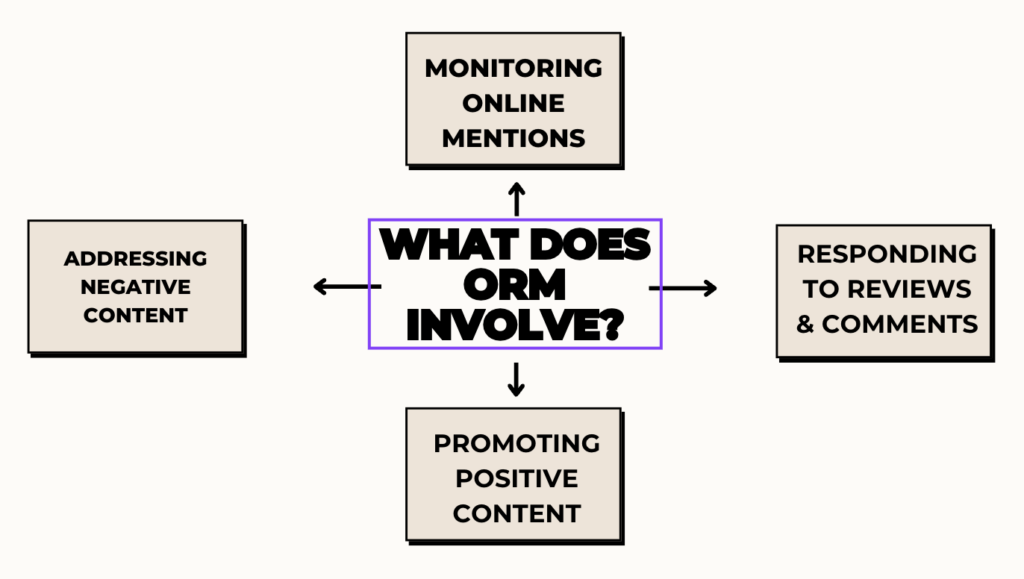
Online reputation management isn’t a one-time fix, it’s an ongoing process. Here are its core components:

  • Monitoring online mentions: This means keeping an eye on what people are saying about you on review sites, blogs, social media, forums, and even news articles.
  • Responding to reviews & comments: Whether it’s a glowing five-star review or harsh criticism, how you respond matters. Timely, thoughtful replies can turn a negative into a positive and show you care about your reputation.
  • Promoting positive content: This includes publishing blog posts, customer testimonials, case studies, or media coverage that highlights your strengths. The more good content out there, the more it pushes negative or irrelevant results down.
  • Suppressing or addressing negative content: ORM doesn’t always mean deleting negative comments (which often isn’t possible). It’s about addressing the issue head-on, resolving complaints, and building so much positive content that the bad stuff gets buried or recontextualized.

6 Key Platforms That Influence Your Online Reputation

Your online reputation is shaped by more than just your website. It also includes:

  • Google search results
  • Review sites like Yelp, Trustpilot, and G2  
  • Social media platforms like Facebook, Twitter (X), LinkedIn, Instagram  
  • Online forums like Reddit and Quora  
  • Blog posts (yours or others’)  
  • News sites and press releases

Proactive vs Reactive ORM

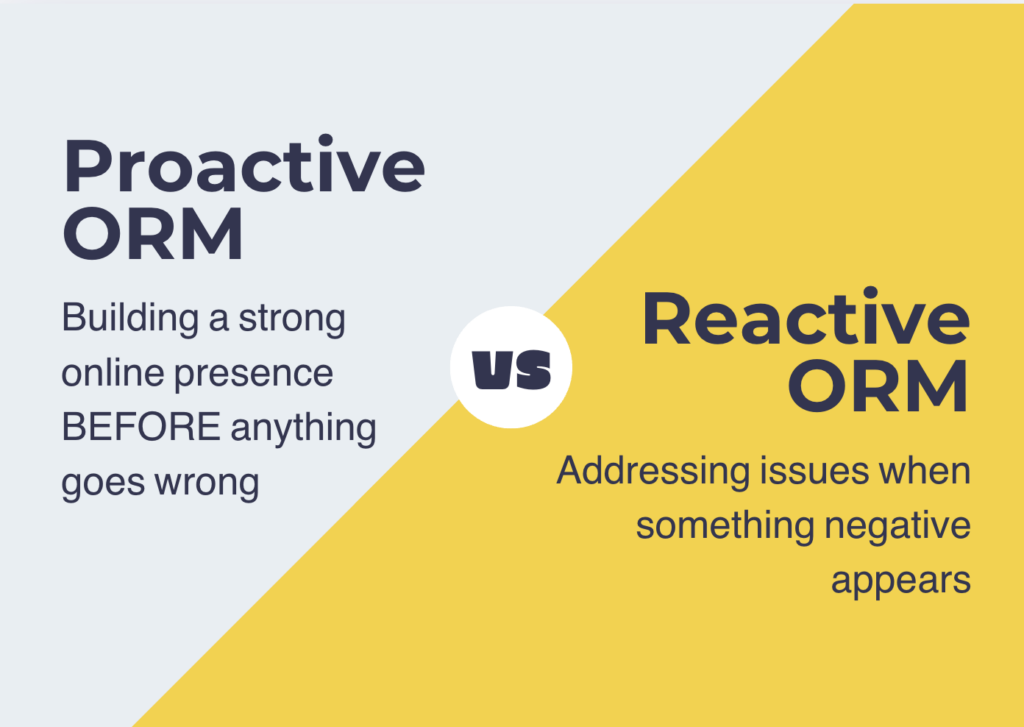
There are 2 ways to approach ORM: proactive and reactive.

Proactive ORM is all about building a strong online presence before anything goes wrong. You create valuable content, encourage happy customers to leave reviews, and stay active online so you stay in control of the narrative.

Reactive ORM kicks in when something negative appears. A bad review, a misleading article, or a social media backlash. It focuses on damage control and reputation repair.

Ideally, you want to do both. Think of proactive ORM as wearing sunscreen, and reactive ORM as treating a sunburn. One protects your reputation in the long run, while the other helps when trouble shows up.

Why Is Online Reputation Management Important?

Online reputation management isn’t just about looking good online. It affects whether people trust you, buy from you, or even find you on Google. These days, one review or comment can spread fast and change how people see you, even if you’re not part of the conversation.

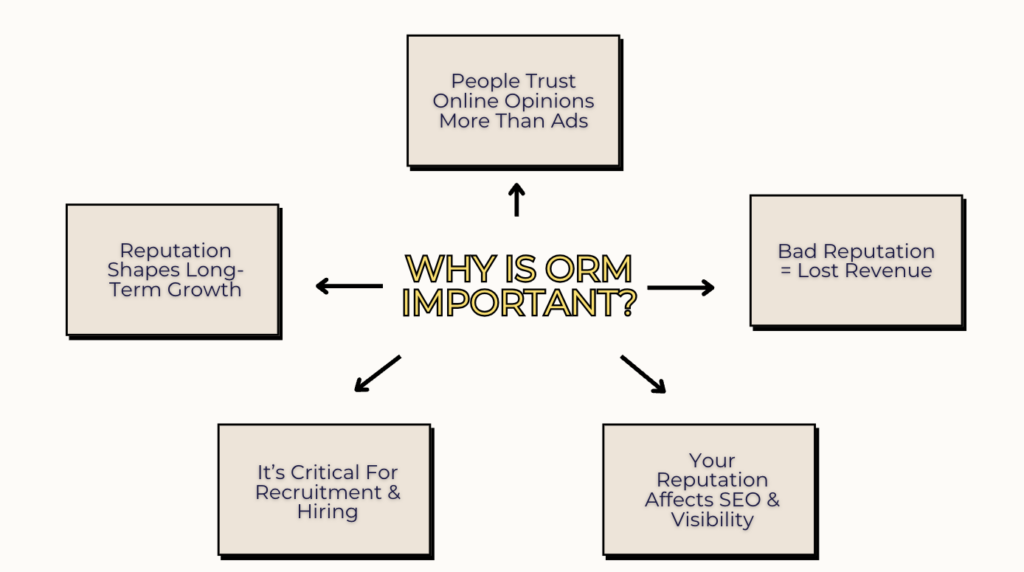
Here’s why it really matters:

1. People Trust Online Opinions More Than Ads

Before making decisions, people look you up. In fact, 93% of consumers read online reviews before buying a product. Reviews are today’s word-of-mouth, only they’re permanent and public. 

What’s more, 84% of people trust online reviews as much as a personal recommendation when they’re recent and relevant. That means your reputation online is your first impression whether it’s your Google Business profile, Yelp page, or LinkedIn search result.

2. Bad Reputation = Lost Revenue

A few negative reviews or an unanswered complaint can cost you business. Harvard Business School found that  a one-star increase in a Yelp rating can generate a 5–9% increase in revenue. Flip that around, and a one-star drop can hurt your bottom line.

And it’s not just about reviews. A poor or outdated online presence can cause potential clients or employers to go with a competitor even if your service is better. People assume your online image reflects your real-world professionalism.

3. Your Reputation Affects SEO & Visibility

Google wants to show users the most relevant and trustworthy content. That includes user reviews, star ratings, mentions in the press, and high-quality backlinks. If your brand is associated with trust and positive engagement, Google is more likely to feature your content prominently.

Also, tools like Google’s E-E-A-T guidelines (Experience, Expertise, Authoritativeness, Trustworthiness) mean your reputation can now influence your search rankings. If people question your credibility, so might the algorithm.

4. It’s Critical For Recruitment & Hiring

Your online reputation doesn’t just affect customers, it influences potential hires. 86% of job seekers check out employer reviews and ratings before applying for a job. A negative employer brand can not only drive away top talent but cost you more to attract them.

Companies with strong reputations see a 28% reduction in turnover and spend 50% less per hire. That’s how closely your public image is tied to internal success.

5. Reputation Shapes Long-Term Growth

Whether you’re building a business or a personal brand, your reputation compounds. A consistent, positive online presence builds trust over time, bringing in:

  • More referrals
  • Better customer retention
  • Increased brand authority
  • Greater resilience during crises

On the flip side, reputation damage, especially if unmanaged, can take years to recover from. You can’t control everything people say about you, but you can control how you respond and what you amplify. Let’s dive deeper into that a bit. 

What Happens If You Ignore Your Online Reputation?

Ignoring your online reputation doesn’t make problems go away, it just lets them shape how others see you without your input.

What Can Go Wrong?

Negative Reviews Gain Traction

A single bad review isn’t a dealbreaker, but when it goes unanswered, it can become the dominant voice. 94% of consumers say a bad review has convinced them to avoid a business. No response often reads as “we don’t care.”

Customer Complaints Can Go Viral  

Social media gives frustrated customers a megaphone and they use it especially when they feel ignored. One unresolved tweet or TikTok video can quickly spiral into a public relations headache.

Rumors And Misinformation Spread

If you’re not actively monitoring your brand, false information on blogs, forums, or review sites can spread. Once Google indexes it, it can live at the top of your search results for months or even years.

What Are The Consequences?

Lost Sales And Leads

89% of consumers check online reviews before making a purchase. If what they find is negative or worse, unaddressed, they’ll go with a competitor who looks more trustworthy.

Lower Search Visibility

Google factors in review quantity, recency, and quality when ranking local results. Poor engagement or consistent negativity can lead to declines in local SEO rankings, making you harder to find.

Higher Costs To Recover

Once your reputation takes a hit, cleaning it up isn’t easy or cheap. Crisis PR campaigns, paid reputation repair, or legal consultations can cost thousands and take months to show results.

Bottom line? Not managing your online reputation means you’re handing the mic to everyone else. If the loudest voices are unhappy ones, it’s your brand and your business that pays the price.

How Online Reputation Management Works + Examples

Online reputation management isn’t a one-time fix, it’s a continuous process. Whether you’re a business owner or building a personal brand, managing your reputation means staying active, aware, and authentic across every online channel.

Here’s how it works, step by step:

Step 1: Audit Your Online Presence

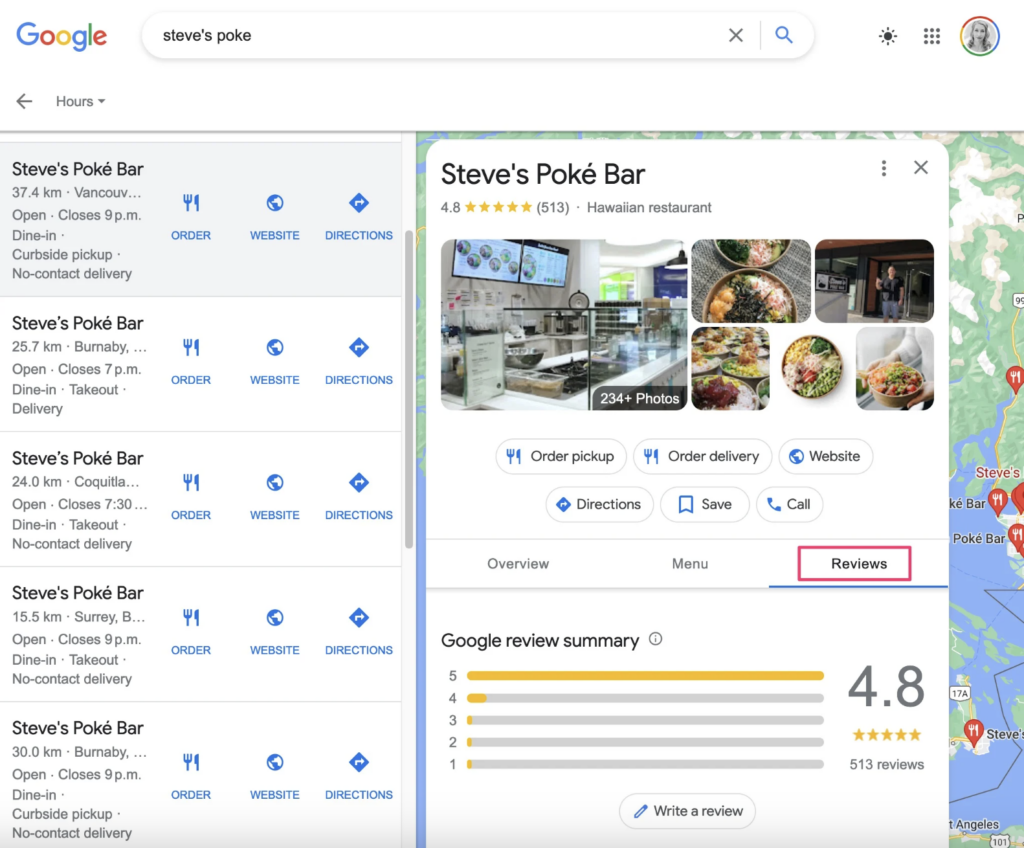
Start by searching your name or business on Google. What shows up on page one? Check your social media profiles, review sites (like Yelp, Trustpilot, Google Business), blog mentions, and forums.

You are looking to answer:

  • What are people saying?
  • Are there negative reviews or outdated information?
  • Does your brand reflect your values?

Example

After a quick search, you notice most people are landing on an outdated product page that doesn’t reflect your current inventory. Your Google listing is missing new product categories, and one review mentions confusion about whether you carry certain accessories.

You update your listings, refresh your homepage content, and make sure popular sections like this golf cart accessories page are easy to find and clearly linked from your social profiles. With those updates in place, search results start highlighting more accurate, helpful content, and customer questions drop noticeably.

Step 2: Set Up Monitoring Tools

You can’t respond to what you don’t see. Use free tools like Google Alerts or paid ones like Mention, Brand24, or Reputology to get notified when someone talks about your brand.

These tools track:

  • Mentions across the web and social media
  • Keyword alerts tied to your name or business
  • Sentiment trends (positive, negative, neutral)

Example:

After setting up alerts, you get notified about a blog post reviewing your service, something you would’ve missed otherwise. It’s positive, so you leave a quick thank-you comment and share it on social media.

Or negative comments are piling up on Facebook and Twitter, and people are frustrated that no one received a heads-up. You quickly join the conversation to acknowledge the issue and explain the steps you’re taking. 

To avoid this in the future, you set up a real-time emergency notification system so you can send instant updates to customers by voice or SMS whenever there’s an urgent change or outage. 

Step 3: Respond to Reviews & Comments

A review, positive or negative, is a chance to build trust. Thank people who leave great feedback. When facing criticism, stay calm, professional, and solution-focused.

Tips:

  • Use templates to streamline responses (but personalize them)
  • Respond within 24–48 hours when possible
  • Take sensitive conversations offline if needed

Example

For businesses in the outdoor living space or home improvement, reviews often mention product durability. One customer leaves a 2-star review saying products like these outdoor cabinets didn’t hold up in coastal weather (which is ironic because it should be built for this kind of weather).

The company responds promptly, apologizing, offering a replacement, and linking to their updated line of weather-resistant outdoor kitchen cabinets designed for tougher climates. The reviewer updates their rating, and new shoppers see the brand’s accountability in action.

Step 4: Create Positive Content

Don’t just react, create. Publish blog posts, high-quality images, case studies, customer success stories, or press releases that show your values, expertise, and results. Hire an expert to create content that can push negative or irrelevant results lower in search rankings.

Ideas to create:

  • Blog articles with industry tips
  • Video testimonials from happy clients
  • Behind-the-scenes content or employee stories
  • Press coverage or award announcements

Example

After noticing that older, mixed reviews were showing up high on Google, you publish a blog post answering common customer questions and add fresh testimonials to your homepage. Over the next few weeks, that content starts ranking higher and gives people something better to click and trust.

Step 5: Engage On Social Media

People expect you to be present and responsive. Comment back, reshare customer stories, and join conversations that matter to your audience. Engage on your social channels, automate when needed, to help build authority and humanize your brand.

Example: 

You notice someone tagging your product in a story with great feedback. Instead of just liking it, you reshare it, add a thank-you message, and respond with a short tip to help them get even more out of the product. Not only do they become repeat customers, but they tell others and now you’ve got free word-of-mouth working for you.

Step 6: Work With Experts When Needed

If you’re overwhelmed or facing a serious issue like negative press or a fake review attack, it’s worth getting professional help. ORM agencies and tools can guide strategy, offer cleanup services, and protect your brand at scale.

Example: 

After a string of fake one-star reviews hits your Google profile, you reach out to a reputation management agency. They help you flag and remove fake reviews, launch a content campaign to highlight real customer stories, and improve your search results over the next few months. Without help, it would’ve taken much longer to bounce back.

Reputation management isn’t about faking perfection. It’s about showing up consistently and being honest. Respond thoughtfully, post regularly, and lead with integrity. Over time, people trust not just what you sell, but how you show up online.

Who Needs Online Reputation Management?

See if your brand fits into one of these categories.

Small Businesses  

Local service providers, restaurants, salons, and clinics live and die by word of mouth and today, that means reviews. A few bad ratings on Google or Yelp can scare off new customers. Managing your reputation helps you show off great service, respond to feedback, and build trust in your community.

 E-Commerce Brands  

When your entire business runs online, your reputation is your storefront. Product reviews, influencer mentions, social media comments all of it shapes buyer decisions. A strong ORM strategy helps you stay ahead of negative feedback and highlight your best customer experiences.

Solopreneurs & Freelancers  

If your name is your brand, what people find when they Google you matters. Whether you’re a coach, consultant, designer, or writer, your reputation affects referrals, pricing power, and client trust. Managing it means making sure your best work and feedback are easy to find.

Corporations  

Bigger companies face bigger risks. One employee tweet, viral video, or unhappy customer post can turn into a crisis overnight. That’s why brands invest in ongoing monitoring, crisis response strategies, and reputation repair to catch issues early and protect long-term trust.

Job Seekers & Professionals  

Recruiters and hiring managers Google applicants every time. If your LinkedIn is outdated, or if a random comment from years ago shows up in search results, it can affect opportunities. Managing your digital presence helps you look polished, reliable, and ready.

How To Manage Your Online Reputation

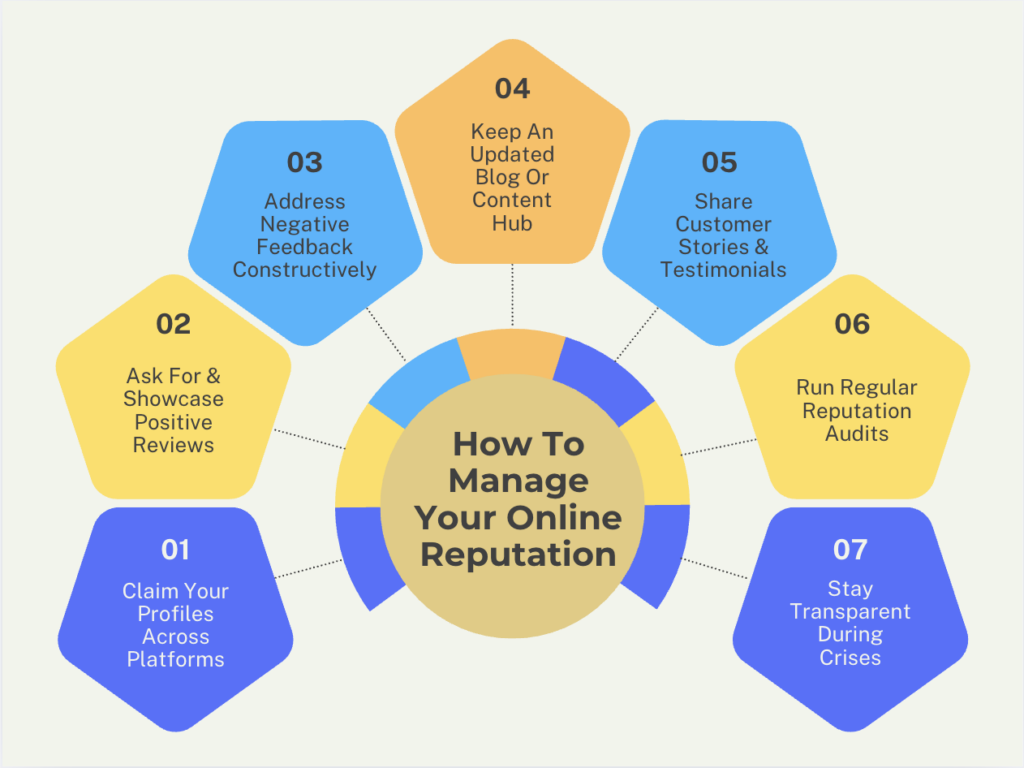
Managing your online reputation doesn’t have to be overwhelming. It’s about building habits that keep you visible, trustworthy, and in control of your story. Here’s how you can do it consistently:

I. Claim Your Profiles Across Platforms

Secure your business name (or personal name) on platforms like Google Business, Yelp, Facebook, Instagram, LinkedIn, and industry-specific directories. Even if you’re not active on all of them, claiming your profiles prevents confusion and keeps someone else from pretending to be you.

II. Ask For & Showcase Positive Reviews

Happy customers usually won’t leave a review unless you ask. Make it easy for them to send a quick link or follow up after a purchase. Once you have great reviews, work with marketing experts to feature them on your site, in marketing materials, and on social media to build credibility.

III. Address Negative Feedback Constructively

Negative reviews aren’t the end of the world, they’re a chance to show how you handle tough situations. Respond politely, take responsibility if needed, and offer to make things right. Your reply isn’t just for the reviewer, it’s for everyone else reading.

IV. Keep An Updated Blog Or Content Hub

Publishing fresh content signals that you are active, knowledgeable, and trustworthy. A blog, resource section, or content hub also gives you control over what ranks in search results. Share tips, answer FAQs, or highlight your values.

V. Share Customer Stories & Testimonials

Real experiences from real people are powerful. Share screenshots of reviews, create short video testimonials, or write up case studies. This kind of social proof builds trust faster than any sales pitch.

VI. Run Regular Reputation Audits

Don’t wait for a crisis to check in. Once a month or at least quarterly Google your business, read recent reviews, and scan social media mentions. Look for trends, outdated info, or anything that might need attention.

VII. Stay Transparent During Crises

If something goes wrong, be upfront. Acknowledge the issue, explain what you’re doing to fix it, and follow up publicly. People don’t expect perfection, they expect honesty. Being transparent builds more trust than silence ever will.

Conclusion

Reputation is built over time, but it only takes one misstep to damage it. Managing it well means being proactive, responsive, and real every step of the way.

If you re not sure where to start or you’re ready to take your brand’s online presence seriously, 99robots offers their expertise in managing your online presence.

Ready to take control of your reputation? Visit 99robots and get a customized plan that keeps your online presence working for you, not against you.

The post What Is Online Reputation Management And Why Is It Important? appeared first on 99 Robots.

PR For Startups: A Definitive Guide For Marketers In 2025

Without a strong PR strategy, your target audience will not hear your story, and competitors will dominate the conversation.

In this article, we will dive deep into PR for startups and how to craft a PR plan. We will also share the tested public relations tactics to build your credibility. 

By the end, you will know how to develop creative PR content, secure press coverage, connect with journalists, and position your brand for success.

Beyond The Buzz: How PR Puts Startups On The Map

PR for startups means you will use strategic storytelling and media outreach to:

Gain customers

Attract investors

Build awareness

How does it work?

PR is more than just press releases or sending cold emails to journalists. It is about crafting a company’s story in a way that makes people care. You need to create a narrative that resonates, whether it is about:

Disrupting the market

Solving an industry problem

Sharing a compelling founder journey

Then, you use media relations to connect with the right journalists, bloggers, and influencers who can amplify that story across different media channels.

Here’s what else is in it for your startup if you do PR:

I. Drive Organic Growth

Unlike ads, PR stories have a lasting impact. A well-placed feature can continue to bring traffic and interest long after publication. Suppose you are a marketer at a fintech startup and you earned a feature in Forbes that highlights how your products help millennials save money effortlessly.

Weeks later, personal finance bloggers link to it, and YouTube creators mention it in reviews. The result? Steady organic traffic, more app downloads, and ongoing brand recognition—without spending a dime on ads.

II. Strengthen Talent Acquisition Efforts

A strong PR presence attracts A+ talent through better employer branding. When your startup is featured in industry publications or news articles, it signals to potential hires that your company is an exciting place to work.

For example, let’s say you are at a fast-growing AI startup and you got it featured in WIRED for its groundbreaking work in automation. The article highlights your innovation, workplace culture, and visionary leadership. Weeks later, the best engineers and data scientists start applying—not because of a job ad, but because they want to be part of something big.

III. Support Crisis Management

PR is not just for good news. If issues arise, having established media relations lets you control the narrative and protect your reputation. Strong media relations mean journalists cover your side of the story—not just the crisis.

Let’s say your food-tech startup employer is facing backlash after a supply chain issue delays orders. Instead of letting rumors spread, you can quickly respond with a transparent statement on news sites to explain the fix and reaffirm customer trust. 

The result? Reputation stays intact, and trust is restored faster than if you stayed silent.

From Unknown To Unstoppable: Building A Winning PR Strategy

Go through each step with a critical eye and outline the most relevant takeaways. Later, when you meet with your team, you will have a practical roadmap to shape your startup PR strategy.

Step 1: Define Your PR Goals 

Jumping into PR without clear goals is like pitching journalists with no story—you will not get results.

A good PR strategy is more than just being featured in media outlets. You need to make sure that those features drive real business impact

What To Do

Know what you want your PR team to do. Do you need to:

Establish credibility

Drive website traffic

Build brand awareness

Each goal requires a different PR approach. Then, make sure you align your PR goals with business goals. So if you are launching a product, focus on securing media reviews. 

Meanwhile, if you are expanding into a new market, target industry-specific media outlets and local business publications to establish credibility with potential customers and partners in that region.

To make this step much more effective, use the SMART framework:

Let’s say you are a marketer at a startup in the outdoor niche like this backyard patio provider. Here’s what your PR SMART goal can look like:

Here’s the overall goal statement:

Within the next 3 months, secure 5 media features in top home improvement blogs and outdoor living magazines to establish credibility and build brand awareness for our patio covers. Our PR team will pitch to 10 targeted media outlets, tracking published articles, audience reach, and referral traffic to ensure success—just in time for peak patio renovation season.

Step 2: Craft Your Company’s Story

Even the best PR professionals cannot generate meaningful buzz without a story worth telling. Before launching a PR campaign, you need a clear, compelling narrative that makes people care about your startup. Use a well-crafted story to build your foundation for a strong brand identity.

In addition, your company’s story can:

Give journalist a reason to cover you

Help your customers connect with your brand

Make sure your messaging stays consistent across every channel

What To Do

Define your mission statement. To do this, clarify what the company stands for and why it exists. Keep it short, powerful, and aligned with your long-term vision, like this one from Slack:

Highlight your core company values or the principles that guide the business. Whether it is innovation, sustainability, or customer-first service, your values shape your marketing strategy.

Next, make your stories relatable because great ones should connect on a human level. Share the brand’s journey—what problem led to the startup’s creation and how does your product or service solve it?

For example, let’s say the startup is in the health tech niche like one of these shoes for elderly fall prevention. As the marketer for the company, here’s how you can pose the story:

This story connects because it is real and emotional—many families worry about aging parents losing mobility after a fall. In fact, 1 in 4 seniors falls annually, leading to 3 million emergency department visits annually. So instead of just selling shoes, this story highlights a relatable problem: seniors want to stay active, but traditional shoes do not offer safety or style.

By sharing a personal journey, you can build trust with caregivers and older adults who want a solution that feels empowering, not restrictive.

Then, package all that into a media kit. Include the startup’s origin story, key milestones, leadership bios, and brand messaging in a media kit that journalists can easily reference.

Step 3: Choose Where Your Story Gets Heard

A successful PR strategy is not about getting featured everywhere—it is about getting featured in the right places.

Your PR efforts should focus on relevant media outlets and social media platforms where your target audience already spends time. If you choose the wrong channels, your story gets lost. The goal is to put your brand in front of decision-makers, potential customers, and industry influencers who actually care.

What To Do

Identify where your audience gets their news. To do this, put yourself in their shoes. What blogs, podcasts, or industry sites do they follow? Which social media platforms do they engage with most? 

If your audience is discussing industry trends on LinkedIn but ignoring Twitter, focus your PR efforts there. You should also look at where your competitors are featured. Study their news stories and see which relevant media outlets cover them. If they are getting attention there, you can too.

Also, match channels to business goals. If you are launching a B2B product, aim for trade publications, business podcasts, and relevant discord channels. If you are consumer-facing, prioritize lifestyle blogs and social media platforms like Instagram or TikTok.

To help you with all these, hire a PR agency. Their experts can help research and compile the best channels for your public relations campaigns. 

Step 4: Create Press Releases & Outreach Pitches

Choosing the right channels does not mean journalists working there will already cover your startup just because you exist—they need a reason to care. If you do not frame your story in a way that grabs attention, your media coverage efforts will fall flat.

Use this step to develop strategic communications that position your brand as newsworthy. 

What To Do

Find a newsworthy angle. Ask yourself:

Why would a journalist care? 

Launching a product is not enough. You should:

Tie it to a trends

A problem you are solving

Industry insights that media professionals find valuable

As for the content itself, make the press release clear and concise. Get to the point fast. A press release should have a compelling headline, a strong opening, and a quote that adds depth—not fluff. 

Here’s a press release example:

For the outreach pitch, personalize it since many journalists will ignore generic emails. To do this, research their work, reference a recent article, and explain why your story fits their audience.

But you should use strategic timing when sending your pitches. Send them early in the week and align them with relevant industry events or trending topics.

Lastly, follow up without spamming. If you do not hear back, wait a few days and send a short, polite follow-up. A successful pitch is about persistence, not pestering.

Breaking Through The Noise: 5 PR Tactics For Startups

Choose the PR tactics that fit your startup’s needs. Note key actions you can take right away and start mapping out your next steps.

1. Create A Dedicated “In the News” Or Press Page To Showcase Your Startup’s Media Wins

Your startup’s media mentions are powerful—if people can find them. Create a press page on your site but make sure it is more than just a collection of links. Use it as a tool to:

Impress investors

Secure media coverage

Build trust with customers

Journalists researching the startup can also use it as quick access to your news announcements. Plus, potential customers love seeing credibility from news publications they trust.

Here’s an example of Box’s press page:

Here’s how to make the “In The News” page effective:

Include downloadable media assets, company background, and press contacts.

Add high-quality logos from every outlet that has covered your startup to boost credibility.

Hire a digital marketing agency that does web design, like 99Robots, to make your press page look professional and guarantee seamless navigation.

Refresh your page regularly with the latest news announcements, PR campaigns, and interviews.

Do not just list links—add summaries and standout quotes from each feature to create engaging content.

2. Use Social Media For PR To Turn Your PR Campaigns Into Shareable Moments

If you do not amplify it on social media channels, you are leaving exposure on the table. Why?

The media landscape moves fast, and getting featured is not enough; you need to turn press mentions into ongoing conversations. Use this strategy to extend your reach, drive social media engagement, and make your campaign part of a larger industry dialogue.

Do this right and you will increase your brand visibility and strengthen building media relations for future coverage.

Here’s how to use social media for your PR campaigns:

Pull a key quote, tag the journalist, and add an engaging caption. Here’s an example: “This startup is redefining sustainable fashion with zero-waste designs.’ Huge thanks to @JournalistName & [Publication Name] for featuring our mission! Read the full story here: [link] #SustainableFashion #PRWin”

Leverage trending hashtags to tie your PR campaign to relevant trending topics for extra reach.

Summarize major PR wins through short videos or behind-the-scenes clips to make them more shareable.

3. Leverage Paid Media Partnerships To Maximize The Impact Of Your PR Efforts

PR is known as earned media, but paid media partnerships can amplify your reach and get your message in front of the right audience faster. Relying only on organic coverage can limit exposure, especially in today’s competitive marketing mix.

So use this approach to secure high-quality exposure without waiting for journalists to pick up your story.

Here’s how to leverage paid media partnerships effectively:

Run targeted social or display ads featuring your earned media mentions.

Use native advertising to blend your content into respected media platforms for seamless exposure.

Partner with content creators who have strong media contacts and trusted audiences.

Invest in sponsored content and publish in-depth articles in top industry publications to position your brand as a thought leader.

4. Partner With A Non-Competing Brand For PR To Create Newsworthy Collaborations

Startups often struggle to build relationships with major media outlets, but partnering with another brand can change that. Get a strategic collaboration to create a fresh, newsworthy angle journalists want to cover.

Plus, instead of promoting your company alone, you leverage a like-minded brand’s credibility, audience, and reach. Use this to:

Strengthen your public relations strategy

Generate company news that feels bigger than a standard announcement

For example, let’s say you have this B2B marketplace for buying and selling online businesses. Partner with a leading M&A advisory firm specializing in small business acquisitions. Together, you can release the “2025 Small Business Exit Trends Report”, which analyzes real transaction data, valuation shifts, and buyer behavior.

If the report secures a feature on Forbes, it will position both your companies as industry experts. Instead of a routine marketplace update, it can become major industry news that will help you build relationships with investors and business brokers. 

Here’s how to choose a partner and work with them effectively:

Look for a company that serves the same customers but is not a direct competitor.

Make sure their brand values align with yours because a misaligned partnership can hurt your credibility.

Launch a joint initiative, like an awareness campaign or industry report.

Host an event together, like a webinar, live Q&A, or in-person networking event, to attract press and customers.

Cross-promote on social media and share each other’s company news to maximize visibility.

Issue a co-branded press release and frame your collaboration as an innovative solution to an industry challenge.

Run a joint giveaway or offer bundled deals to engage both audiences.

5. Get Media Training For Your Founders To Deliver Powerful, Newsworthy Interviews

As a marketer, you can write the perfect pitch, secure top-tier media placements, and build an effective PR strategy—but if your founders stumble in interviews, the impact is lost.

Remember, journalists want strong, engaging sources, and a hesitant or unprepared founder can weaken your brand’s credibility. Meanwhile, media training helps them:

Control the narrative

Speak with confidence

Turn every press opportunity into a compelling story

When your founders know how to handle tough questions, highlight key messages, and engage audiences, your PR efforts become far more effective.

Here’s how to get media training for your founders:

Show them how to pivot from tricky questions back to their key messages.

Improve body language and tone since confidence is not just about words; eye contact, posture, and tone matter.

Train them for different interview formats because they need to be comfortable with live TV, podcasts, panel discussions, and written Q&As.

Hire a professional media coach to teach your founders how to handle interviews and stay on message.

Simulate real media interviews with tough questions so your founders practice staying composed under pressure.

Make sure they have clear, repeatable talking points that align with your effective PR strategy and business goals.

Conclusion

Review your PR efforts and choose one tactic to act on now. If you have media mentions but aren’t maximizing them, create a dedicated “In the News” page to showcase your wins. Need broader reach? Leverage paid media partnerships or collaborate with a non-competing brand.

Track what is working and what is not—do not just set it and forget it. If a tactic is not getting traction, tweak your approach, and test a new angle. PR is a long game, and momentum comes from smart adjustments.

To help you with your PR journey, 99Robots’ expertise in marketing can come in handy. We can help create your PR content or integrate your PR mentions on your website. Contact us now and let’s see how we can boost your public relations efforts.

The post PR For Startups: A Definitive Guide For Marketers In 2025 appeared first on 99 Robots.