Most business owners see marketing as a form of selling. And, sure, the point of many marketing campaigns is to build brand and product awareness and elevate prospects’ purchase intent. But customer education can play an equally important role in driving growth. The thing about unhindered business growth is that it’s not necessarily the result of a big ad spend. Instead, it’s a direct outcome of a company’s relationship with its potential customers.
So, what drives consumers to form relationships with (and preferences for) specific brands? It can be a variety of factors, including emotional marketing campaigns, aspirational brand associations, and trustworthy business reputations. But if you look at the most effective marketing approach for facilitating brand growth, you’ll find that it’s clarity-building, user-centric, goal-oriented informational value.
Prospects who understand what they need in terms of a solution to their pain points are far more likely to recognize the value of your offer (and convert) than those experiencing confusion or having doubts. That’s why customer education is essential for gaining a competitive advantage in modern, saturated markets.
With this in mind, we’ll show you the best ways to boost your customers’ product knowledge. The goal? Ensuring they perceive your offer as the ideal solution to their needs and choose to buy from your business; not just once but for many years to come.
Product Evaluation Education Builds Customer Confidence
One of the biggest benefits of investing in customer education is that it builds customer confidence.
But why is customer confidence important in the first place?
Well, if you look at consumer psychology, you’ll find that uncertainty directly harms conversion potential.
Shoppers who are not confident in their product category knowledge don’t feel comfortable making a buying decision (no matter how big or small). Instead, they’re far more likely to experience a stress response during the buyer’s journey, exhibit risk aversion, or avoid making a decision entirely. And that makes it extremely hard to turn prospects into customers.
So, one of the most important conversion barriers to eliminate from your marketing funnel is a lack of general product category knowledge.
By investing in evaluation education, you can teach your customers the specific criteria they need to consider when comparing product quality.
But why focus on explaining criteria rather than strengthening your website messaging? Because branded claims aren’t always the best (or most trustworthy) source of shopping advice. Instead, most consumers prefer to either rely on peer or expert recommendations while navigating the purchase decision-making journey. By elevating evaluation literacy, you can empower potential customers to make informed shopping decisions based on their personal requirements and priorities.
In other words, this educational approach doesn’t prescribe a (potentially) effective solution to your target audience’s pain points. Instead, it teaches your prospects to make a positive decision without relying on someone else’s reasoning (an approach that ensures the highest level of alignment between customer confidence and purchase intent).
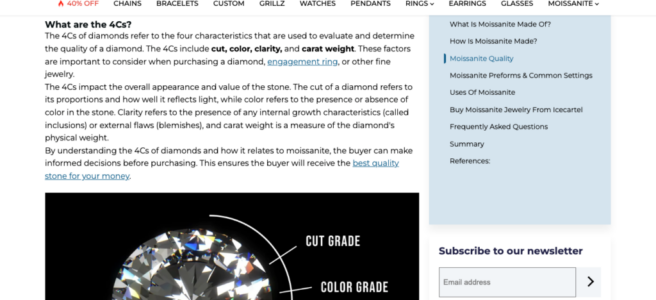
If you check out IceCartel’s blog post explaining moissanite stones, you’ll find that the primary goal of the resource is to build customer confidence through educating leads about relevant product evaluation factors. In the guide, IceCartel doesn’t tell potential buyers which moissanite stones are the best choice. Instead, it teaches jewelry shoppers how to assess and differentiate moissanite stones using the 4Cs gem-quality criteria. This empowers potential buyers with practical knowledge about the product category and the insights they need to make a buying decision that’s right for them and their unique preferences.

Source: icecartel.com
Goal-Based Education Helps Customers Choose the Right Product
Product education-related conversion barriers can have a real detrimental effect on consumers’ movement through the buyer’s journey.
But, in many cases, the cause of low purchase intent or poor customer confidence isn’t that your prospects don’t understand the general benefits of your solutions. Instead, it’s that your inventory includes too many similar options (each with a different ideal use case) and your prospects aren’t sure which one they need.
In psychology, this is called choice overload. Essentially, when shoppers have too many options to choose from, a common effect is that they start to experience pressure, confusion, and frustration, all emotions that hurt the decision-making process.
If you recognize choice overload in your sales funnel, the best way to gain a competitive advantage through customer education is to help your leads choose the right product from your offer by focusing on their desired outcomes.
This marketing approach works marvelously because it connects each item in your inventory to a specific customer goal.
By explaining how different product characteristics are suited to different intended outcomes, you can reduce your web visitors’ uncertainty and prevent them from experiencing choice overload.
For example, check out Performance Lab’s blog post explaining the differences between magnesium malate and magnesium glycinate, two forms of the same micronutrient. Performance Lab uses this type of educational content because it knows that non-expert shoppers looking for a magnesium supplement usually don’t understand the different benefits of each option. Instead, they have an intended benefit they want to receive. So, by aligning each option with a specific outcome (energy and endurance vs. stress relief and sleep support), the brand ensures that prospects understand what each option does and helps its customers make the best possible choice for their needs, instantly boosting customer confidence and post-purchase satisfaction.

Source: performancelab.com
Preference Education Makes Product Discovery More Efficient
Research suggests that 73% of consumers expect brands to understand and meet their unique needs and expectations. And that shouldn’t be much of a surprise. With the growing demand for personalization over the past few years, the minimum that each business should do is ensure its marketing messaging aligns with customer wants.
But what if your target audience isn’t entirely sure what they’re looking for?
One of the primary benefits of customer education isn’t just that it teaches leads how to resolve their pain points. It can also instruct your prospects to identify and describe their preferences, knowledge that your brand can then use to its advantage in product categories where purchasing decisions are highly subjective.
In other words, preference education helps your potential customers define their specific needs. When done well, it can streamline their product evaluation and selection journey and move them closer to a conversion within a shorter time span.
One of the best ways to approach this education marketing strategy is to give shoppers a clear product classification system. The goal isn’t necessarily to help them find what they want immediately. Rather, it’s teaching them how to eliminate unsuitable options and narrow a large selection down to something manageable, where they can easily discover products that fit their tastes.
For instance, check out how Scentbird does it in its blog post describing different fragrance families. This brand sells a monthly perfume subscription. But it’s well aware that a large portion of its target audience isn’t that experienced with scents and fragrance families. So, to ensure that first-time buyers select the right products to receive (which they’ll genuinely be happy with), Scentbird educates web visitors about fragrance families, encouraging readers to identify their preferences and narrow down their product selection to items they’re most likely to want and enjoy.

Source: scentbird.com
Production Education Reduces Uncertainty Around Custom Orders
In some cases, customer education isn’t simply valuable because it empowers your target audience to make smart purchase decisions they won’t regret. For some businesses, it’s an essential part of the product marketing journey because it manages shopper expectations in verticals where uncertainty is an inevitable part of the customer experience.
In industries where consumers can’t see or try the final product they’ll be receiving, it’s not uncommon for shoppers to feel a lack of confidence. And while trust marketing can remove some customer qualms, it’s not always sufficient to overcome the conversion barrier posed by ‘the unknown,’ especially for custom orders.
In these situations, one of the best methods to reduce uncertainty is to educate leads about your production process.
By teaching your customers what happens during production, you can elevate their understanding of your products and their decision-making-confidence. Furthermore, you can help them comprehend precisely what happens in the moments between product ideation and delivery.
The benefits of demonstrating the product production process don’t just stop at reducing doubt. They can easily extend to showcasing the value and justifying the price of your offer, a purchase factor that’s particularly important in industries where consumers seek value for money.
Custom Sock Lab does a tremendous job of implementing this educational marketing tactic in its blog post about how socks are made. In this guide, the brand shows how an idea progresses through the custom sock manufacturing process. In doing so, it doesn’t just familiarize potential customers with its production process. It also gains a valuable opportunity to highlight the main competitive advantages of its offer, including its attention to quality and detail, material origins, quality control, order delivery, and turnaround times.

Source: customsocklab.com
Planning Education Simplifies Complex Purchase Decisions
Some purchase decisions are relatively simple. Some aren’t even rational, but rather the result of an emotional impulse. But some require a great deal of thought and foresight. And it’s precisely this last scenario that most often causes customers to experience informational overwhelm while moving through the buyer’s journey, a psychological phenomenon that significantly reduces people’s chances of completing a purchase.
Does your business operate in a highly complex niche where shoppers need expert-level product understanding to guarantee satisfaction? Then your primary goal should be to simplify complex purchase decisions through planning education.
By providing this type of guidance to your target audience, you can gain a significant advantage over competitors that don’t help shoppers make complex interconnected pre-purchase decisions.
The goal is simple. Don’t leave shoppers to have to research each of their buying decisions without the support they need. Instead, aim to help them identify and work through the practical variables that determine which product configuration best suits their project.
Pergola Kits USA does this beautifully. On its homepage, it presents web visitors with an in-depth guide to choosing shade structures based on coverage, anchoring capabilities, materials, and assembly options. By doing this, Pergola Kits USA ensures that potential customers know exactly what they want before they’ve even started browsing products. On the one hand, this results in much faster movement through the sales cycle. On the other hand, it ensures that customers feel confident and supported throughout the shopping process, which elevates Pergola Kits’ advantage over its competitors.

Source: pergolakitsusa.com
Post-Purchase Education Helps Customers Get More Value From Products
Real brand growth doesn’t happen from customer acquisition alone. Instead, the longevity and success of your business directly depend on your customer retention rates.
According to the Harvard Business Review, increasing customer retention by as little as 5% can boost profits by up to 95%.
There are plenty of customer experience factors that will influence your customers’ willingness to remain loyal to your business. But if you’re looking for low-cost, high-ROI marketing tactics to ensure buyers stick with your brand, post-purchase support and education are some of the best ways to guarantee satisfaction.
Educational resources that teach leads how to use, maintain, or get better results from products after purchase are especially beneficial in giving you a competitive advantage because they help customers get more value from your products. Satisfied customers will be far more likely to recommend your brand and products. And they may even turn into vocal brand ambassadors who will gladly support your reputation as the best provider of products and services in your niche.
Of course, to reach this goal, you need to be adamant about providing immense post-purchase educational value.
Focus on helping your customers get as much as possible out of each purchase. Help them resolve and avoid common usage issues. And provide care instructions to extend the lifespan of their newly bought items, so that they get the most value for money when shopping with your brand.
Weber is a brand that produces splendid post-purchase content, which definitely contributes to its reputation as one of the top grill manufacturers in the US. Its website content focuses on helping customers troubleshoot common technical issues, ensure proper equipment maintenance, and perfect their grilling skills for maximum recipe success. By doing this, Weber gives customers everything they need for a smooth and satisfying product experience, and makes them very likely to recommend the brand’s solutions to friends and family looking for the same type of product.

Source: weber.com
Final Thoughts
Customer education needs to be a core aspect of your marketing strategy. Do it right, and you won’t just reduce buyer uncertainty and streamline the buyer’s journey. This approach can also help you emphasize the unique value your solutions bring to the table or ensure your customers get the most out of their purchases.
So, take a look at your brand’s content and find opportunities to present informational value to your audience.
Investing in such resources won’t take up that big of a chunk of your marketing budget, but the ROI is bound to be significant.
The post How Customer Education Is a Competitive Advantage for Modern Brands appeared first on 99 Robots.